
Survive the Holidays Without an Insurance Claim
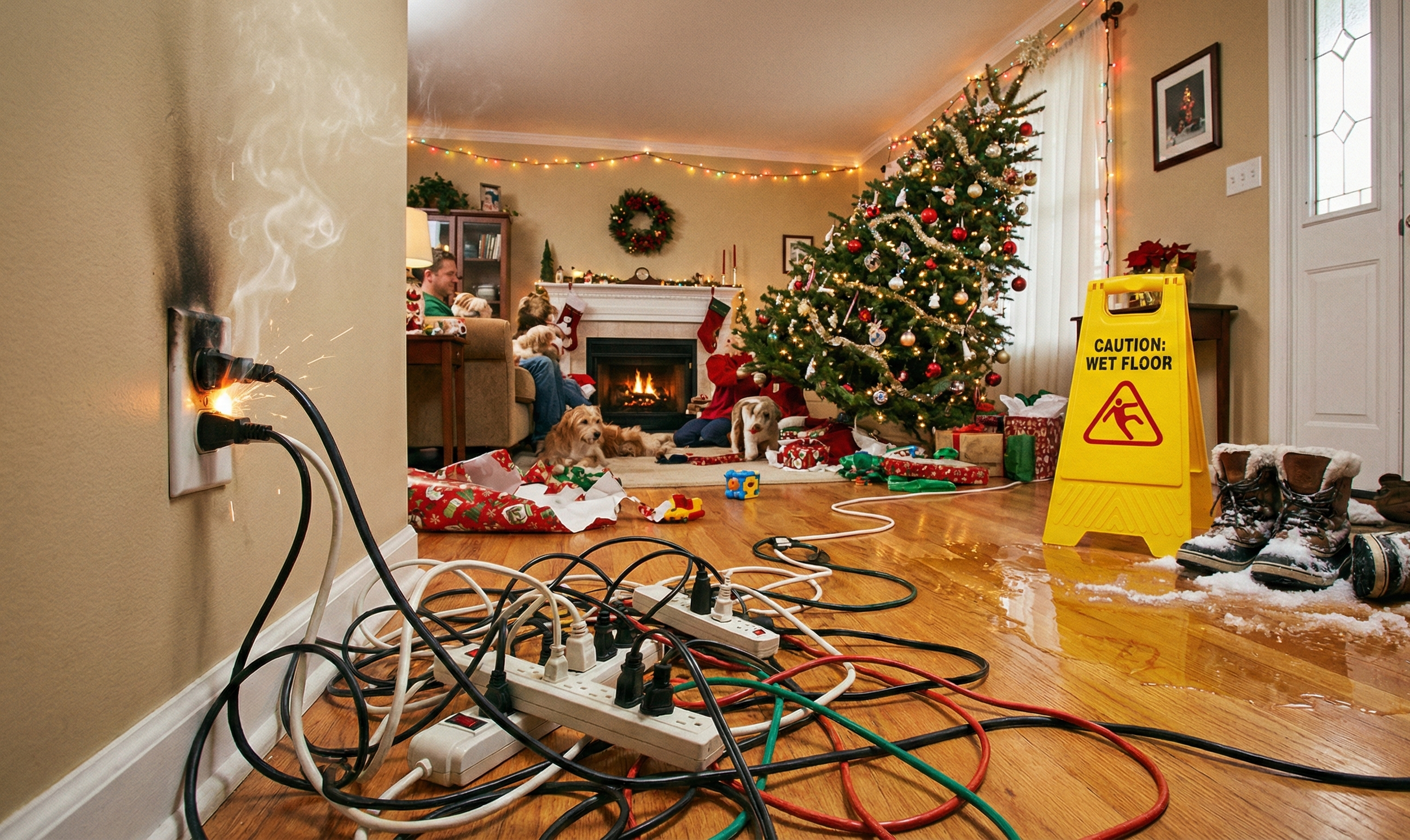
The holidays are a magical time of year. They are also a time when we invite fire hazards into our living rooms, climb ladders on icy driveways, and crowd 30 people into a kitchen designed for four.
From a risk management perspective, Christmas is a nightmare. From a homeowner's perspective, it’s a lot of work.
We want you to enjoy the eggnog, not spend Boxing Day filling out incident reports. Here is your Risk Management Guide to navigating the festive chaos.
1. The Clark Griswold Syndrome (Ladders & Lights)
Every year, emergency rooms see a spike in injuries from people falling off ladders while hanging lights. We appreciate your commitment to neighborhood aesthetics, but gravity doesn't take a holiday.
The Rule of Two: Never climb a ladder alone. You need a spotter—someone to hold the base and to call 911 if you decide to test the laws of physics.
Electrical Overload: Daisy-chaining ten extension cords into a single power bar is a fire risk, not an engineering feat. If your outlet looks like a spaghetti monster, you are overloading the circuit. Switch to LEDs; they use less power and generate less heat.
Inspect the Wires: If you’re pulling lights out of a storage bin and the wires are frayed or chewed (mice love Christmas too), throw them out. It is cheaper to buy new lights than to repair smoke damage.
2. The Turkey: A Delicious Fire Hazard
Cooking a turkey is stressful. Deep frying a turkey is dangerous. Every year, insurers see claims for garages and decks that have been incinerated by deep fryers.
Take it Outside: If you insist on deep frying, do it on concrete, away from the house, and nowhere near a wooden deck.
Don't Overfill: Displacement is real. When you drop a 20lb bird into boiling oil, that oil has to go somewhere. Usually, it goes onto the open flame.
Stay in the Kitchen: For standard oven roasting, do not leave the house. Unattended cooking is a leading cause of home fires.
3. Liability: The "Wet Shoe" Danger
You have 20 guests, snow is melting in the entryway, and Uncle Bob is on his third festive beverage. This is a recipe for a slip-and-fall.
The Boot Zone: Establish a strict "boots off" zone with heavy-duty mats to trap melting snow. Hardwood and tile become skating rinks when wet.
Shovel the Walk: You have a duty of care to keep your walkways safe for delivery drivers and guests. If someone slips on your icy walk, you are liable. Keep a bag of salt or sand by the door.
4. The "Sparkly" Gift: Scheduling Jewelry
If you are planning to be the hero this year and buy your partner jewelry, you need to think about the paperwork.
Standard home insurance policies usually have a Special Limit on jewelry (often around $6,000 to $10,000 total, with limits per item). If you buy a ring or a watch that exceeds that limit, it is not fully covered for theft or "mysterious disappearance" (losing it).
The Action Item: If you buy a high-value item, email us the appraisal immediately. We will "Schedule" (or Floater) the item. This ensures it is covered for its full value, often with a lower deductible.
5. The Porch: (Amazon Deliveries)
Between now and December 25th, your front porch will likely see more traffic than a major airport. Delivery drivers are dropping off packages, and opportunistic "Porch Pirates" are driving around looking for them.
While theft is a crime, from an insurance perspective, it’s a math problem.
The Deductible Reality: Yes, your home insurance covers theft of personal property. However, if your deductible is $1,000 and someone steals a $150 Lego set, you don’t have a claim.
The "Work" Address: If your boss allows it, ship packages to your office. It is much harder to steal a package from a staffed reception desk than from a dark front step.
Tech & Lockers: Video doorbells are great deterrents, but they often just provide high-definition footage of your stuff being stolen. Consider using Amazon Lockers or Canada Post FlexDelivery for high-value items. It adds an errand to your day, but it guarantees you actually get the gift.
We aren't trying to be the Grinch. We just know that the difference between a "Great Christmas" and a "Disaster" is usually just a little bit of common sense and preparation.
Stay safe, keep the ladder steady, and if you get something shiny, let us know so we can protect it.